Case study · 2026 · working integration pattern
NetSuite × Agentic AI: Connecting NetSuite to Claude via MCP.
Letting AI agents like Claude and ChatGPT query and update NetSuite data safely — using the Model Context Protocol as the bridge, with role-based permissions, schema validation and full audit logging.
1The challenge
Finance and operations teams increasingly want to use AI assistants like Claude and ChatGPT to interact with NetSuite — asking natural-language questions about customers, invoices, projects, and supply chain, and triggering routine actions like creating draft journals, posting reconciliations, or running saved searches. But naively exposing NetSuite to an AI agent creates immediate, serious problems:
- Permissions disaster — giving the AI an Administrator role means every prompt has god-level access to your finance data
- Audit black hole — when the AI updates a record, who actually did it? Auditors and SOX controls need traceability
- Prompt injection risk — a malicious customer email parsed by an AI assistant could trick it into running arbitrary NetSuite operations
- Schema chaos — AI agents hallucinate. Without strict input validation, you get malformed records, broken references, and corrupted data
- Cost runaway — without rate limiting and read/write segregation, a misconfigured agent can rack up API governance units in minutes
The result: most teams either give up, or build something fragile that works in demos but fails the moment finance asks for an audit trail.
2The approach
Build a proper NetSuite MCP server. The Model Context Protocol is Anthropic's open standard for connecting AI agents to external systems — it's becoming the de facto way Claude, ChatGPT, Cursor and others talk to business systems. Treating NetSuite as a first-class MCP server lets you expose specific tools to AI, with explicit schemas and permissions, rather than handing over an API key.
The MCP server sits between the AI agent and NetSuite. The agent doesn't get an API key, doesn't see passwords, and can only invoke the specific tools you've exposed. Each tool has a strict JSON schema for inputs, runs under a defined NetSuite role with Token-Based Authentication, and logs every call to a custom NetSuite record for audit.
Reference architecture
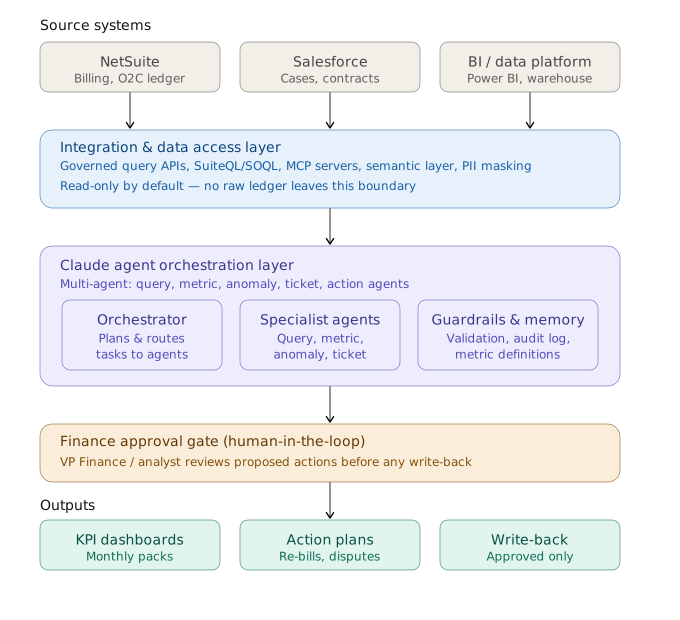
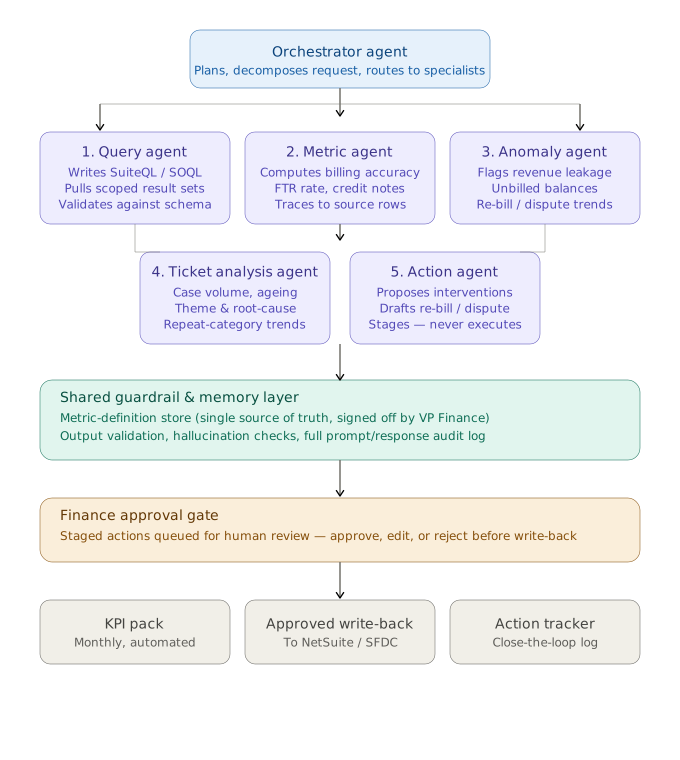
Below is the wider architecture in a real deployment. The MCP server pattern above is the bridge layer; the diagrams show what sits either side of it — source systems feeding governed reads, a Claude agent orchestration layer with specialist agents, a finance approval gate, and the audited write-back path.
3What gets built
The MCP server typically exposes a starter set of tools, with the exact list shaped to the customer's use case.
Read tools (safe by default)
Write tools (require explicit confirmation)
Safety layers
- JSON Schema validation — every tool defines required and optional fields; malformed AI outputs are rejected before they reach NetSuite
- Token-Based Auth (TBA) — the MCP server uses a dedicated NetSuite integration record with a specific role; AI agents never see credentials
- Role-based exposure — read-only roles get only read tools; finance roles get journals; AP roles get supplier-side tools. Same NetSuite permission framework you already use for humans
- Two-phase writes — destructive operations return a preview and require an explicit "confirm" call before executing, preventing single-shot misfires
- Audit record — every tool call writes to a custom NetSuite record: who (agent + initiating user), what (tool + arguments), when, result, and the originating prompt context
- Rate limiting and governance budgets — daily token caps and NetSuite API governance limits per tool, per role, per session
- Prompt injection defence — content fetched from NetSuite (e.g. customer notes, email bodies) is clearly delimited and explicitly marked as untrusted in returned tool responses
4What it unlocks
Finance natural-language queries
"Summarise the top 10 overdue invoices for our UK subsidiary, grouped by customer." Claude calls run_saved_search, fetches the data, and explains it in plain English.
Drafting financial documents
"Create a draft credit memo for invoice INV-12345 with reason: pricing error." The agent calls create_credit_memo in preview mode; a human confirms before it posts.
Cross-system reasoning
Combine NetSuite MCP with Slack, Gmail, or Salesforce MCP servers. The agent can pull a Salesforce opportunity, check the customer's NetSuite credit, and respond in Slack — one workflow, three systems.
Faster onboarding & support
New finance hires ask the agent how to do things in NetSuite rather than waiting for a colleague. The agent walks them through the steps and can perform the action if they have the right NetSuite role.
Audit-ready by design
Every AI-initiated action lives in a custom NetSuite record alongside the human's regular audit trail. SOX-compliant; defensible in a year-end review.
No vendor lock-in
MCP is an open protocol. Today's agent might be Claude; tomorrow's might be ChatGPT or a self-hosted Llama. The MCP server doesn't care which client connects.
5Technologies used
"Most teams either hand the AI an admin key and pray, or build something so locked-down it can't do anything useful. The middle path is an MCP server that exposes specific tools, with NetSuite's own permission and audit framework doing the heavy lifting."